
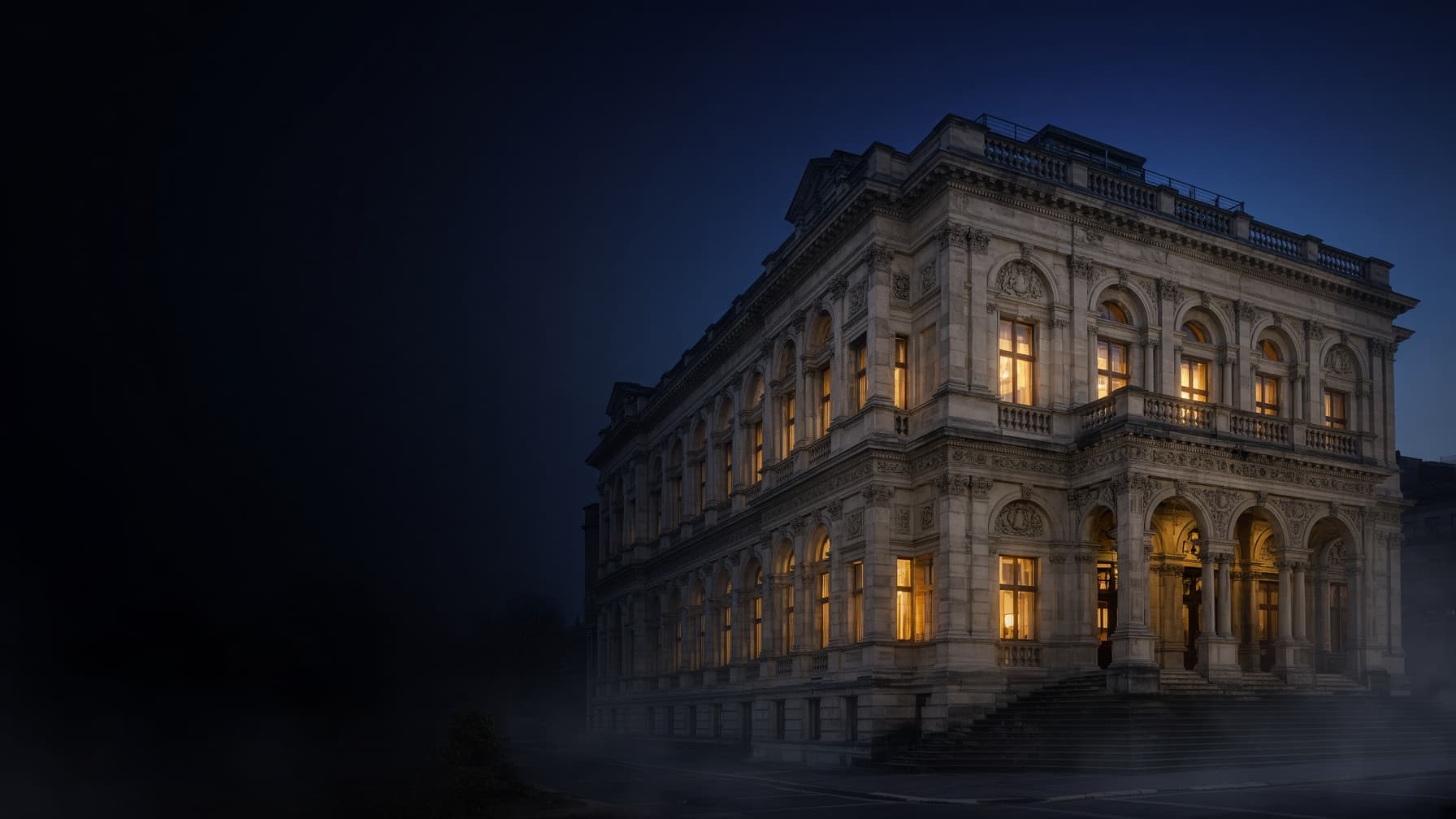
For haunted & historic venue owners
Your building has a story.
Let people experience it after dark.
HauntStay is where haunted and historic locations open their doors at night — ghost hunts, investigations and tours, run by you or by an operator you authorize. The building stays yours either way.
Your building may already be on HauntStay. Find your location — if it is there, you can claim it from its page, and once your claim is approved you control what it says. Claiming is free and commits you to nothing.
The model
They run the event.
You keep control of the building.
Your location, the event, and the person running the event are three separate records on HauntStay — not one record wearing three hats. Letting somebody run a night in your building does not hand them your building.
Yours
The location
The page, the name, the photographs, the documented history, the rules. It does not move when an event does.
Theirs
The event
One night, on a date, at a price they set, with their guests and their equipment. It belongs to whoever runs it.
Them
The operator
A separate identity that runs events — here and, usually, at other locations too. It never stands in for you on your page.
What that means for a venue you have claimed
- Nobody sells a night without you
- An operator cannot create an event at your location until their request is approved. Requesting it grants nothing.
- You are who approves it
- The decision sits with the venue’s own manager, not only with HauntStay.
- You can withdraw it
- Change your mind and they stop taking new bookings. Nights guests have already paid for still go ahead.
- They only touch their own nights
- An approved operator manages their events. Yours, and anyone else’s at the same location, stay out of their hands.
All four of those come with being the claimed owner of the location. An operator can add a building nobody has claimed and run nights there on their own account — guests are told the organiser does not own the place, but there is no owner on record to approve or withdraw anything. Find your location and claim it, and that becomes your decision instead.
Turn unused nights into
preservation revenue.
Old buildings are expensive to keep standing, and the people drawn to them after dark aren’t always the same people who visit during the day. An evening programme reaches an audience who would never book a house tour and who arrive genuinely curious about the place.
The history still matters. A night investigation does not replace what the building is or what is documented about it — it is another way in, for people who will read the timeline on the way past.
On the record
Documented history and reported experience are not the same thing, and the page keeps them apart.
Documented history
A dated timeline of the property — what was built, what burned, who lived and worked there, what the records say. Written as history, presented as history.
Reported experience
What people say they have experienced in specific rooms, and how often. Recorded as accounts and shown as accounts — attributed to report, not asserted as fact.
They live in different places on your listing because they are different kinds of claim. A historic site can take part without its documented record being rewritten as a ghost story.
Two ways to open the doors
Neither is the default, and neither locks you in.
You run the events
You build the night, set the price, hold the dates and take the bookings. Ghost hunts, private investigations, tours, a season of October nights — the listing is yours and so is the event.
An operator runs the event
Somebody who runs paranormal events for a living handles the night — the guests, the equipment, the running of it. Your venue stays the venue: the property page, its history and its rules remain with you.
Arrangements like this start with a conversation rather than a button — contact us and we’ll help set it up.
What a night can be
Public ghost hunts
A ticketed night where several groups share the building up to its capacity.
Private investigations
One group takes the whole date. Nobody else can book that night.
Group experiences
Priced for the group, or per person, or a group rate with extra guests beyond it.
Ghost and history tours
Guided, on a schedule — the daylight history and the after-dark version of the same rooms.
Overnight experiences
Dusk-to-dawn access, where the building and its owner allow it.
Which of these your location can offer depends on the property and on what you permit there.
Getting started
How it works
Create your account
One account, whether you end up running nights yourself or not.
Add or claim your location
If your building isn't on HauntStay, add it. If it's already here as an unclaimed profile, claim it — you'll tell us who you are and how you're connected to the property.
Tell us about the property
History, the rooms, access, house rules, what's off limits, photographs. This is the part only you can write.
Set up payouts
Only if you'll be selling your own events. A venue whose events are run by an operator doesn't need this.
Create the experience
What the night is, how long, what it costs, how many people.
Add your dates
A whole season at once, not one night at a time.
Take bookings
Guests book and pay through your listing.
Run the night
Your roster with party sizes and booking references, who has signed a waiver, and one message to everyone booked.
Before it goes public
A location you own or manage is reviewed by us before it becomes publicly visible. That step exists because listing a building as its owner is a claim about the real world, and guests booking a night in someone’s property are entitled to have it checked. You build the listing at your own pace and submit it when it’s ready; publication follows the review rather than the click.
Your site stays yours
Keep your website.
A historic property usually has an audience already — members, a mailing list, people who have followed the restoration for years. Nothing here asks you to send them somewhere else.
Booking embeds are available for your existing website, so people can book a night without leaving the pages they already trust.
On your own site
“Book an evening at the house”
Your pages, your branding, your audience — with HauntStay handling the dates, the payment and the guest list behind it.
Pricing
No HauntStay platform fee for your event.
HauntStay’s service fee is paid by the guest, on top of your listed price.
Live on HauntStay
A real haunted building already taking bookings on HauntStay.
A historic property isn’t inventory.
A building that has outlasted several owners has rules that came with it — rooms that cannot take a crowd, floors nobody walks on, a staircase that is not for climbing, objects that are not to be touched. None of that is an inconvenience to design around; it is the property, and it belongs on the listing.
So the listing has room for it. Access notes, safety notes and house rules are part of what a guest agrees to before they arrive, not small print discovered at the door. Your property’s name, its story and its limits stay yours to state.
Questions venue owners ask
- Does my building have to be famous for being haunted?
- No. There is no certificate and no threshold. Plenty of historic buildings carry a century of stories and have never been written up anywhere — that is the ordinary case, not the exception.
- My building is already on HauntStay. I didn't put it there.
- Many locations are listed as unclaimed profiles — a page about a real place, with nothing for sale on it. If yours is one of those, you can claim it from its own page: you tell us who you are and how you’re connected to the property, and we review it before anything changes hands. If it already belongs to an account and that isn’t you, contact us — that one needs a person, not a form.
- Do I have to run the events myself?
- No. Some owners run every night themselves; others never run one and let an authorized operator do it. Both are normal, and you can start with one and move to the other.
- Can an outside operator run events at my venue?
- Yes, with your say-so. An operator can request permission to run events at your venue; you see the request where you manage your listings and approve or decline it. Approving lets them create and manage their own events at your location — nothing of theirs is on sale until you do, and it gives them no control over your page, its history, its photographs, its rules, or who holds the venue.
- If an operator runs a night here, do they get my venue page?
- No. Running an event at a location and holding that location are two different things in HauntStay, and they are stored separately. The event belongs to whoever runs it. The property page — its history, its photographs, its rules — stays with the account that holds the venue.
- Who controls what the page says about my property?
- You do, once the listing is yours. Title, description, history, reported phenomena, access notes, safety notes, house rules, photographs and your own website link are all yours to edit, whenever you like.
- Something on my property's page is wrong. How do I fix it?
- If the listing is yours, edit it directly — there’s no queue and no request. If it isn’t yours yet, claiming it is the way to get that control. There is no public correction form, so anything else goes through contact us.
- Can I keep using my own website?
- Yes. Booking embeds are available for your existing site, so people can book a night without leaving the pages you already send them to.
- What does HauntStay charge me?
- See Pricing above — it covers exactly how the guest’s total is made up and what reaches you.
- Can we do private, single-group nights rather than public ones?
- Yes. An experience can be set so that one booking takes the whole date — once a group books it, nobody else can, however small the party.
- Can we host overnight experiences?
- Where the building allows it and you permit it. Overnight access is a property decision before it is a product one, and nothing here assumes every location can offer it.
- We're a historic site. Will this turn our history into a ghost story?
- It shouldn’t, and the listing is built so it doesn’t have to. Documented history and reported paranormal experience are kept as separate things on the page — a dated timeline is not the same record as an account of what somebody says happened in a room, and they are not stored or displayed as if they were.
Your building already has the story.
Now give people a way to experience it.
Rather see the steps first? Walk through setting up.
Run paranormal events across multiple locations? Explore HauntStay for operators →